Piano Storage: Why a Regular Storage Unit Is a Bad Idea
People need to store a piano for ordinary reasons. A remodel. A move with a gap in the middle. A downsize. A piano inherited from a parent's house that has to go somewhere while the family decides.
And the default answer is a self-storage unit, because that's where things go. It's the wrong place for a piano, and the reason is worth understanding — because the damage is invisible while it's happening.
A piano is wood under enormous tension
This is the thing to hold onto. A piano isn't furniture with strings in it.
The strings of a piano are under tens of thousands of pounds of combined tension, held by a wooden frame and a soundboard that are shaped and braced to resist exactly that pull. The whole instrument is a structure in balance.
Wood moves with temperature and humidity. It always has and always will. In a piano, that movement happens inside a structure under load — which is why a piano is far more sensitive to its environment than a dresser sitting next to it.
What a storage unit actually does to it
A standard unit is uninsulated and unconditioned. In the Central Valley that means summer interior temperatures well above what's comfortable, cold in the winter, and humidity that tracks the weather.
Short term, it goes out of tune. The soundboard and frame move, string tension changes, pitch drifts. Expect this after any move — but a stored piano keeps drifting for as long as it's in there.
Over longer periods, things loosen. Glue joints in a piano were assembled to fit tight. Repeated expansion and contraction works them looser. Loose joints buzz, rattle, and eventually need real work.
Veneer and finish suffer. Case veneer lifts when humid air gets under it. Finishes cloud, craze, or go sticky in heat.
In the worst cases the soundboard cracks, or the bridge does. That's structural, expensive, and sometimes not worth repairing.
And then there's everything else in a storage unit. Dust through the action. Concrete floors that wick moisture upward into anything resting on them. Rodents, which find felt and hammers to be excellent nesting material — and a piano's action is largely felt.
The other half: it gets moved twice
Something people don't factor in when comparing storage options.
A piano going into storage gets moved in and moved back out. If the storage plan involves whoever is available and a rented truck at both ends, that's two chances for the moving damage described above — and moving damage is more often what ruins a stored piano than the storage itself.
The cheap storage option frequently isn't, once the two moves are counted honestly.
What proper piano storage looks like
- Indoors, in a stable environment — not a metal box in a Modesto July
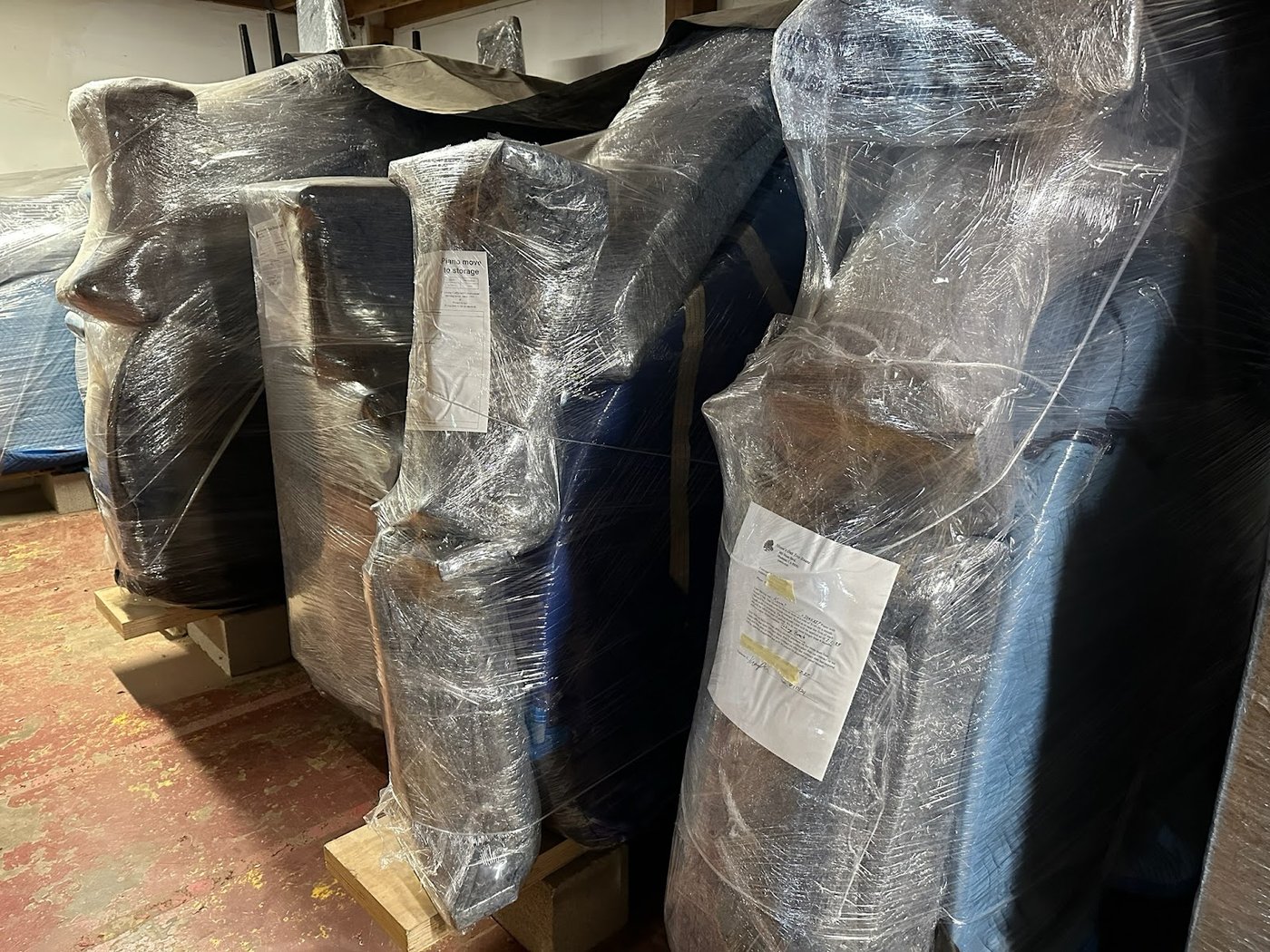
- Wrapped and padded, so the case doesn't take handling marks and dust stays out
- Up off the concrete, on skids or blocking, so nothing wicks moisture from the slab
- Positioned correctly — uprights upright; grands on their side on a proper skid board, legs and lyre removed, which is the standard and correct method
- Tagged and recorded, so what came in is documented
- Moved in and back out by the same people, with the right equipment, as part of the same arrangement
That last point is the practical one. We move it in and we move it back out when you're ready, which is the part people forget to arrange and then improvise badly.
If you're going to use a self-storage unit anyway
Sometimes that's the only option. Reduce the harm:
- Get a climate-controlled unit. Not "indoor" — specifically temperature and humidity controlled. This is the one that matters most.
- Get it off the floor on pallets or blocking.
- Wrap it in breathable material, not plastic sheeting. Plastic traps condensation against the finish.
- Don't stack anything on it, ever.
- Plan on a tuning when it comes out, possibly two as it settles.
Ask us before you book the unit
Tell us what the piano is, how long it needs to be stored, and what's happening at each end. If a storage unit is genuinely the right answer for your situation we'll say so — and if the piano is in rough shape already, storing it may be the moment to decide whether it's coming back out.
We move, store, repair and refinish pianos, so it's one conversation instead of three. Modesto, Ceres, Turlock, Riverbank, Oakdale, Stockton and the surrounding Central Valley, since 1991.
Nixon's Oak Tree House · 301 Maze Blvd, Modesto · (209) 524-6349
Talk to the shop
Bring it by, or send a photo and we will tell you what it needs. Estimates are free and there is no pressure either way.